

Oxygen makes up about 20% percent of the air and is essential to life. Oxygen is most commonly found in the atmosphere as the dioxygen molecule, O2, that is a diradical, as its lowest electronic state is a triplet (3Σg–) state in which two unpaired electrons are distributed in the two highest occupied degenerate orbitals (Figure 1-a). Oxygen in the triplet state (3O2) is not very reactive due to spin restrictions, as most other molecules are in the singlet state, though it will readily react with radicals that are in the doublet state. However, excitation of the molecule will result in the rearrangement of the electron spins and the orbital occupancy to form two possible singlet electronic states, 1Dg and 1Σg+ (Figure 1b and c, respectively), who are highly reactive. The 1Σg+ state oxygen is very reactive and has a relatively short lifetime as it tends to quickly relax to the lower energy 1Δg state. Therefore, the 1Δg singlet state, that is only 23 kcal above that of the ground state, is the state involved in most oxygen reactions that do not involve radicals and is the state that is referred to when discussing singlet oxygen (1O2). The transition between the singlet to the triplet state is considered to be forbidden, and as a result is highly improbable. As a result, the lifetime of an isolated singlet oxygen in the gas phase is relatively long- 72 minutes. This time gets shorter the higher the probability of a collision, meaning the higher the pressure and/or temperature, the lower is the singlet oxygen’s lifetime. In the gas phase, the lifetime can drop to mere seconds, depending on the conditions. In solvents, however, the lifetime gets even shorter, dropping to microseconds or even nanoseconds.
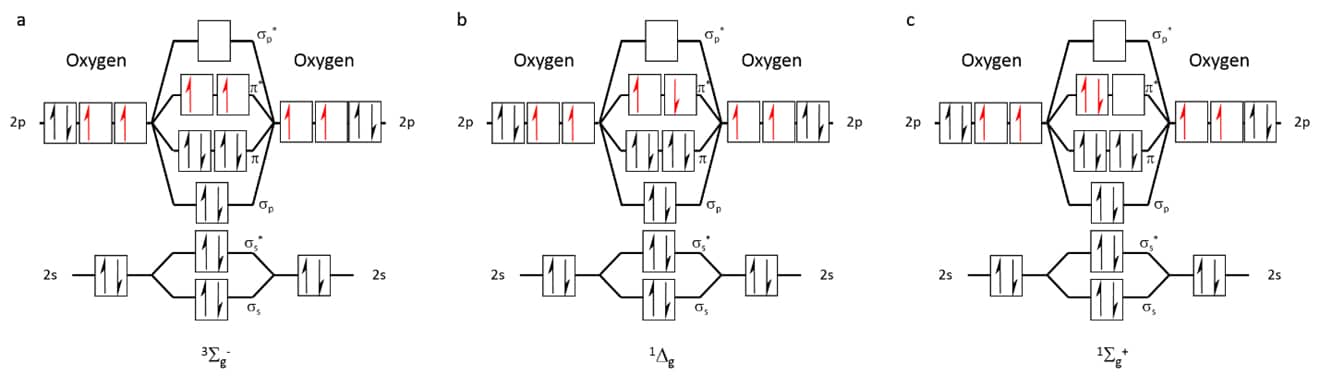
Figure 1 Occupation of molecular orbitals in oxygen at different energetic states: (a) triplet ground state, 3Sg–, (b) Most stable singlet state, 1Δg, (c) Highest energy, short- lived singlet state, 1Σg+.
The ZMedicAir is a one-of-a-kind, patent-protected technology, producing singlet oxygen in a non-radiation-based process and in low levels. This device uses ambient oxygen, converting low levels of it into singlet oxygen by passing it through a metallic honeycomb like apparatus. The unique design and composition facilitate the conversion of oxygen from its natural triplet form to singlet oxygen in low and safe levels.
For more information about the ZMedicAir breakthrough technology, and its benefits to your health, contact us today.